What can a Nordita scientific program make possible?
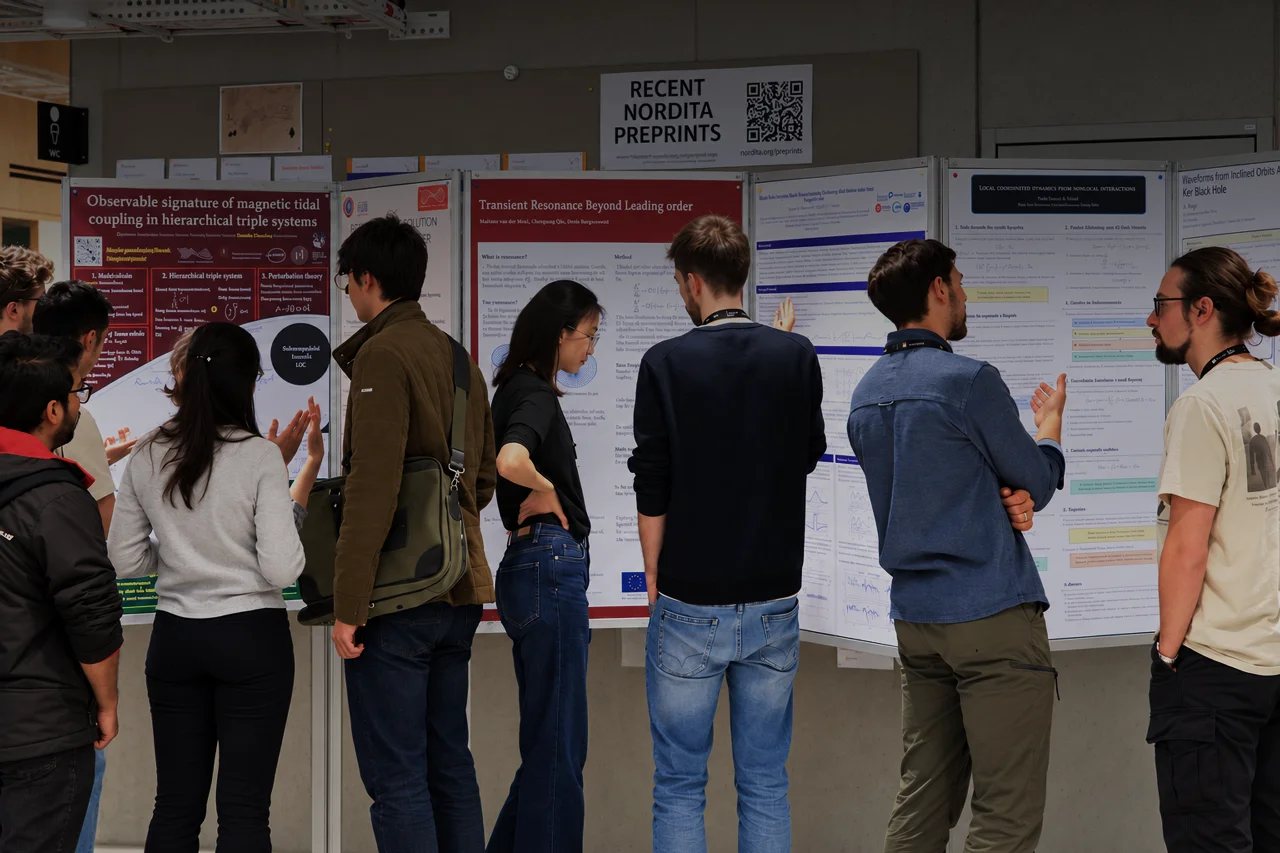
Nordita is now inviting proposals for scientific programs in 2028, with a deadline of 15 November. Experiences from organizers and participants give a sense of what can happen when researchers are given several weeks to work on an important scientific question.
When asked about their experience at Nordita, organizers and participants over the past year have repeatedly come back to a few themes:
new collaborations
new ways of communicating across subfields and approaches
ideas for experiments and publications
time for conversations that would be difficult to fit into a typical conference
space to focus on the science, with practical arrangements taken care of by Nordita's event team
The 2026 program Synergies Between Astrophysical, Space, Laboratory, and Fusion Plasma Physics brought together communities studying the same underlying physics in very different settings, but often using different methods and mathematical frameworks. One aim of this program was to find a common language across these areas.
By the end of the three weeks, several collaborations had already begun, including ideas for laboratory experiments inspired by observations and theories from other areas of plasma physics. Organizers were also preparing a special journal issue and discussing possible joint grant applications.
A similar challenge was addressed during Zoom In: Galaxy Disks Across Cosmic Time, where observers and researchers working with simulations approach many of the same questions from different directions. The three-week format gave participants time not only for talks, but for discussions over lunch and coffee and conversations that could continue from one day to the next.
Organizers Annica Black-Schaffer (Uppsala University) and Adolfo G. Grushin (DIPC) of the 2025 program Topology and Geometry Beyond Perfect Crystals summed up the value of the longer format:
“The three-week format allows ideas to develop and collaborations to form.”
They also highlighted the practical support provided by Nordita’s event team, which allows organizers to devote more attention to the scientific content.
For younger researchers, the extended format can also create opportunities to build networks and encounter new perspectives. Quantum Machine Learning organizer Michele Grossi (CERN) pointed to the possibilities for PhD students and postdocs to interact directly with different research groups and find mentors.
Camilla Thune Nyhagen, a second-year PhD student in Zoom In: Galaxy Disks Across Cosmic Time, said: “I’ve gained new ideas, new perspectives and potential future collaborations.”
PhD student Sara Molisani who participated in the plasma physics program, reflected:
“You gain a better understanding of the same physical process when you see it from the point of view of other plasma environments.”
Interested in organizing a Nordita program?
Nordita welcomes proposals across theoretical physics as well as related interdisciplinary and emerging areas of the natural sciences.
The deadline for proposals for scientific programs in 2028 is 15 November 2026.
Read the proposal guidelines and submit a scientific program proposal.