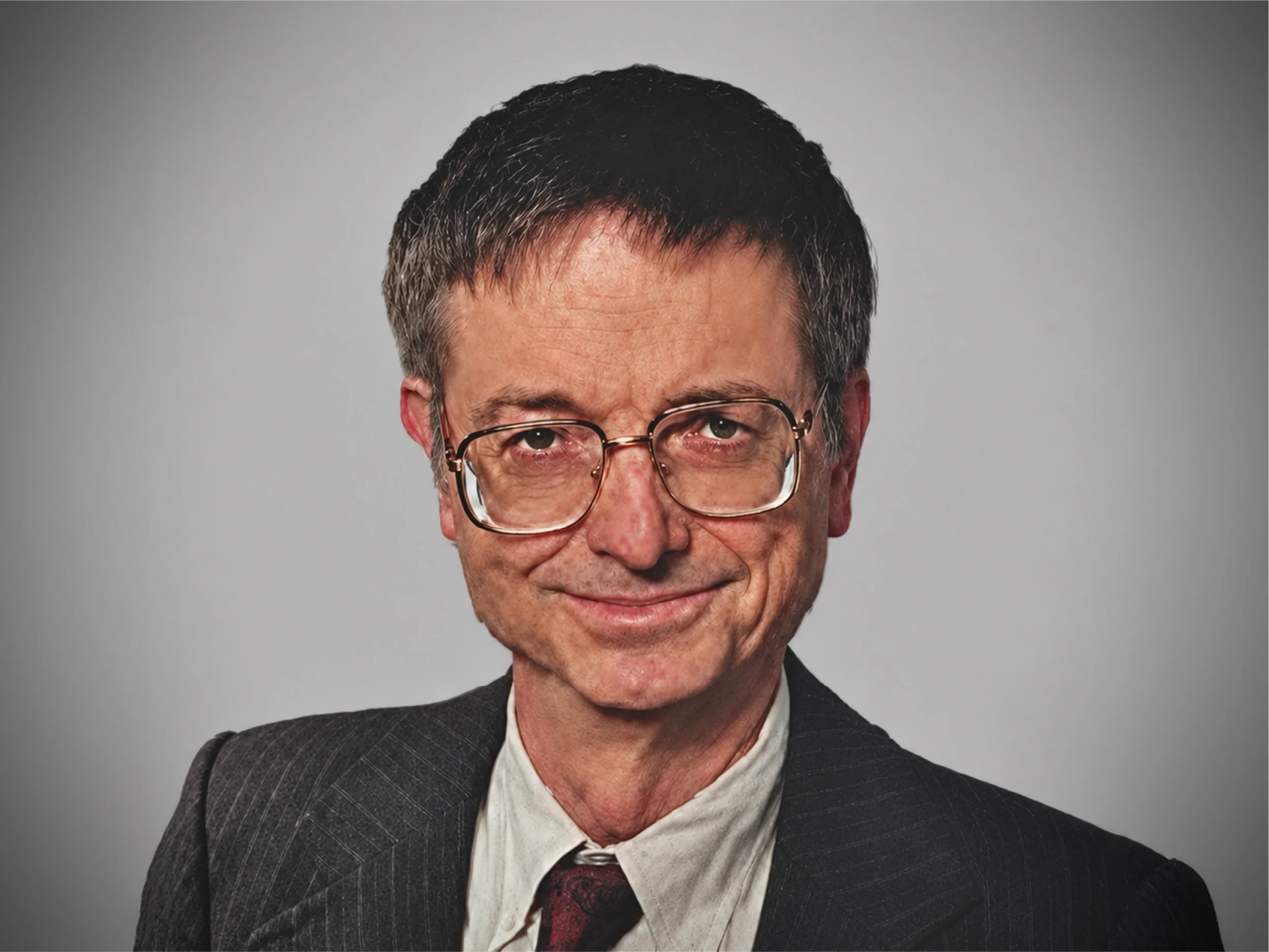
Nordita has learned with sadness of the passing of Nordita emeritus professor Alan Luther.
Alan Luther was a leading theoretical physicist whose contributions to condensed matter physics, particularly the theory of strongly correlated and one-dimensional systems, had a lasting impact on the field. After receiving his PhD from the University of Maryland in 1967 and holding positions at the Technical University of Munich, Brookhaven National Laboratory and Harvard University, he joined Nordita as a professor in 1976.
In 2001, he received the Oliver E. Buckley Prize of the American Physical Society for his pioneering work with Victor J. Emery on one-dimensional Fermi systems.
During more than three decades at Nordita, Alan played an important role in shaping the institute's research environment. We invited colleagues who knew him to share their memories. The reflections below speak to both his scientific contributions and his efforts to build connections between researchers across institutions and national borders.
Alexander Balatsky:
Alan Luther was a defining face of Nordita, and he will long be remembered as such — inseparable from what we now call quantum materials. His work on low-dimensional systems became required reading for generations of students, embodying the deep connection between basic science and real-world challenges that sat at the very core of Nordita's mission. His passing marks the close of an important and impactful era in Nordita's history.
Beyond the science, Alan was the visionary who forged Nordita's exchanges with the Landau Institute in the 1970s and 1980s, at a moment of rapid and uncertain change in the Soviet Union. Those exchanges have transcended physics — I remember scientists returning to the Landau Institute from Nordita visits full of ideas and energy. The discovery of high-temperature superconductivity in oxides fed the energy and made the interactions rare and alive. Alan and Nordita demonstrated how to build an environment where scientific interactions could reach across the East-West divide and bring people together as human beings. In helping to tear down those walls, Alan left a mark far greater than any single result. For some of us, he and those memories are the reason we came to Nordita when the opportunity arose.
Paolo Di Vecchia:
Here I want to mention two important contributions of Alan Luther while he was at Nordita. The first one is a scientific one. He wrote two important papers with I. Peschel (Phys. Rev. B9, 2911 (1974)) and with V. Emery (Phys. Rev. Lett. 33, 598 (1974)) where they study one- dimensional electron gases obtaining results that essentially show the equivalence of two two-dimensional theories as the sine-Gordon one and the Thirring model. Actually, the two previous papers were written when Alan was still at Harvard. When he came to Nordita he continued to work in this direction publishing another paper on the same line (Phys. Rev. 14, 2153 (1976)). Then he tried to extend the bosonisation rules to three dimensions (Phys. Rep.49, 261 (1979) and to four dimensions in a paper with Schotte (Nucl. Phys. B 242, 407 (1984)). In the particle physics community the previous results in two dimensions are known to be obtained by S. Coleman who was also working at Harvard. He published his work on Phys. Rev. 11, 2088 (1975) and in the notes added in proof he writes
"Schroer has also pointed out that many of the results obtained here are in close correspondence with the results of one-dimensional electron gasses by Luther and collaborators. Luther and I are in total agreement with Schroer on this point; we are also united in our embarrassment that we were incapable of reaching this conclusion unprompted. (Our offices are on the same corridor.)"
The other one has been very important for both scientific and political aspects. Together with his friend Khalatnikov working at the Landau Institute in Moscow, Alan organised a few meetings that took place in Moscow and in Copenhagen. Scientists from Nordita collected a number of prominent physicists working in the west and took them mostly to Moscow but also in other places, while Khalatnikov brought a big group of Russian physicists mostly to Copenhagen, but also in other Scandinavian towns. These meetings usually went on for two weeks and were extremely important not only from a scientific, but also from a political point of view in a period in which the two communities were separated and no interaction was allowed because of the Cold War. In my opinion this is a very good example on how important is to keep scientific and human contacts in periods of international turbulences.
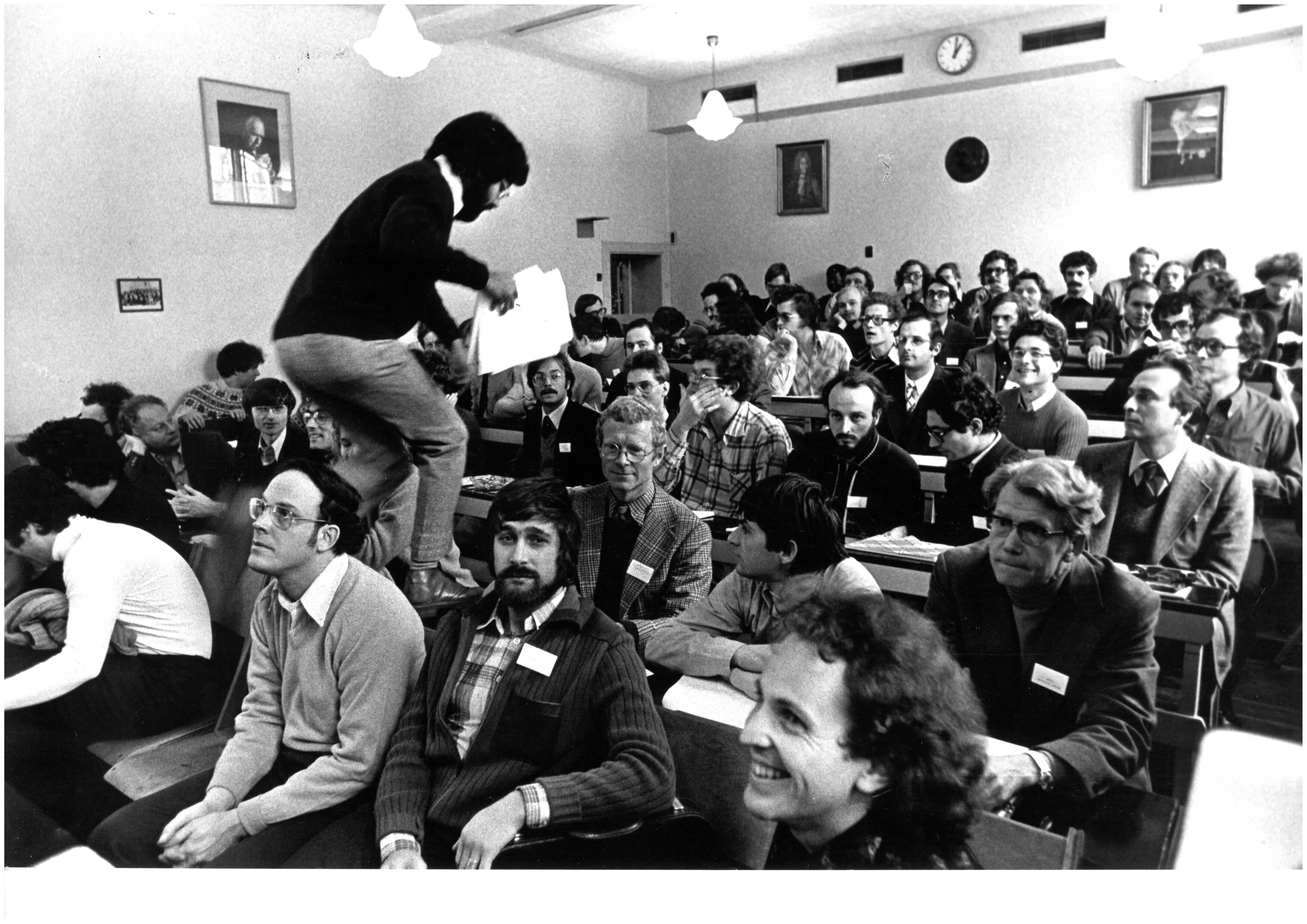
Finally I want to mention that Alan, through his contacts with Khalatnikov, was able to bring Sasha Polyakov to Copenhagen for three months in 1976. This was very fruitful scientifically and at the end of his stay in Copenhagen Nordita organised a conference that was attended by many people. I enclose a picture of this conference where you can see Alan participating.
Christopher Pethic:
Other colleagues have earlier commented on Alan's scientific work and on his leading the joint Nordita-Landau Institute workshops. In this connection, I would stress the important role Alan's extensive network in statistical mechanics, condensed matter physics and field theory in both East and West played in enriching the scientific environment at Nordita as a result of the constant stream of world-leading experts in these areas. Among them was a young Ed Witten, who had yet to receive his Ph.D., if I remember correctly.
There was another side to Alan – his sense of fun. Alan had a dry, low-key sense of humour, which sometimes left listeners in doubt about whether or not he was serious. I also remember the annual photograph at Nordita and the Niels Bohr Institute in 1979. Predrag Cvitanović was travelling, so Alan got one of his daughters to draw a picture of a cat, which was held up in the place of the absent Predrag in the group picture.
One of Alan's passions was music. At the time when Alan came to Nordita, Ragtime had had a revival and he would regale us with Scott Joplin songs on the piano.
John Hertz:
I remember Alan first for his wonderful creativity as a theoretician. When he found a new technique or a way to look at a problem from a new angle, he was like a kid with a new toy.
And of course I think about his organisation of the exchanges with the Landau Institute, which were a focal point of my research life for a decade. Not just the conferences, but also all the individual visits by Landau physicists to Nordita, which gained me many lasting friendships with Russian colleagues.
Most of all, I remember how Alan and his family welcomed my family and guided us into our Danish life in the years after I first came to Nordita back in 1980. Our children had a special fondness for him, and whenever they came to the institute, they would rush to Alan’s office and he would entertain them. I never listened in on these conversations, but I think they regarded him as some kind of magician. We worried that they would be testing his patience and told them it was time to go after a while, but he never gave any sign of being tired of them. They, too, were moved and saddened to learn about his passing.