Nordita Research Spotlight #1 - Could hidden “sound waves” in the dark universe help explain the Hubble tension?
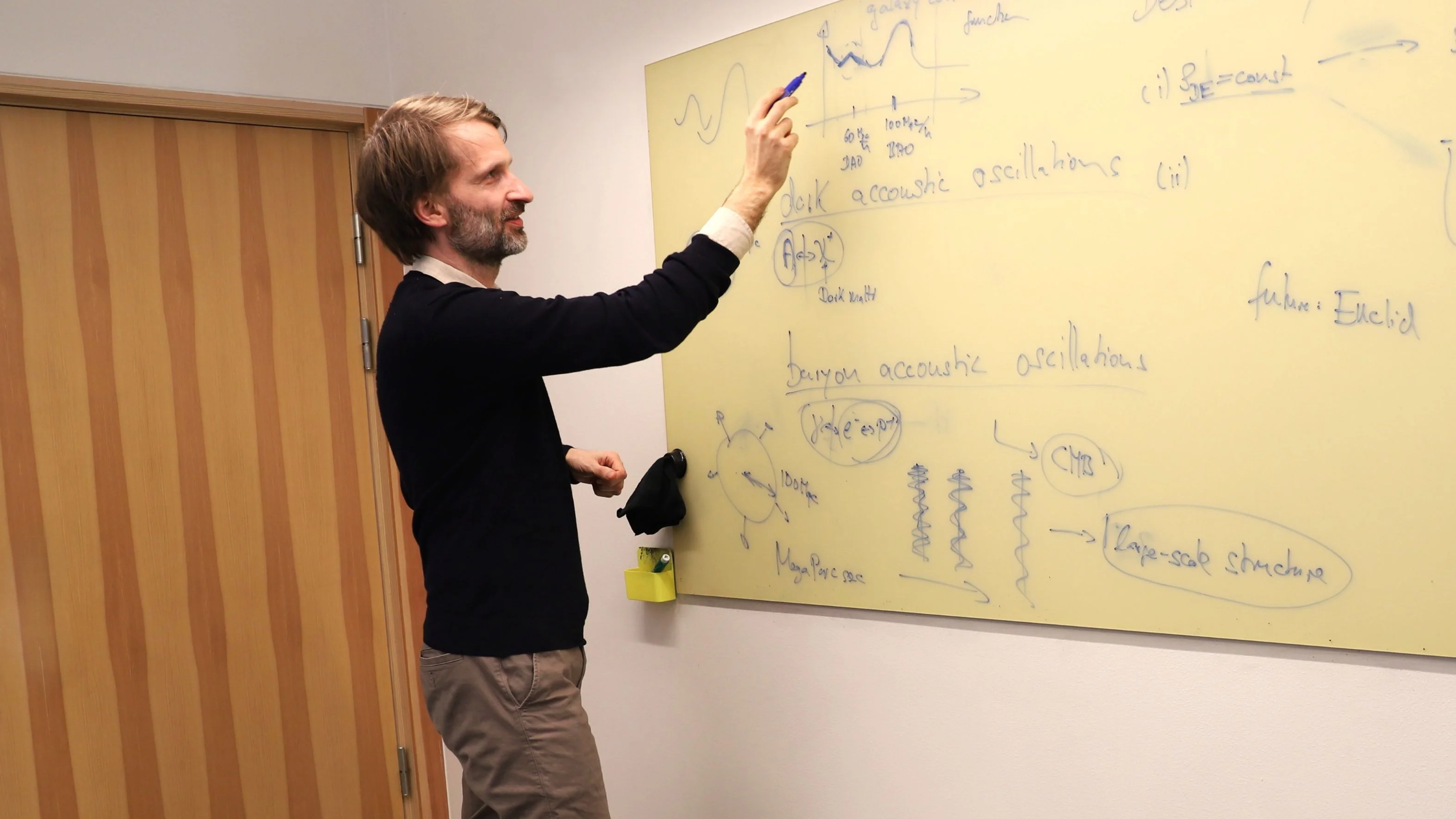
At the whiteboard, Florian Niedermann points to a small extra bump in a curve, a subtle feature that could help explain one of cosmology’s biggest puzzles.
The puzzle is known as the Hubble tension: different methods of measuring how fast the universe is expanding give different answers.
Today, physicists estimate this expansion rate in two independent ways. One uses the cosmic microwave background (CMB), light released around 400,000 years after the Big Bang and often described as a photograph of the early universe. The other uses supernovae, exploding stars that help map cosmic distances.
Both methods should give the same answer. Instead, they produce values around 67 and 73 (in units of kilometers per second per megaparsec), with uncertainties that do not overlap.
“That’s what we call a tension,” Niedermann explains. “Two independent measurements of the same quantity disagree, even though they should be measuring the same thing.”
One possibility is that one of the measurements is flawed. Another, arguably far more intriguing one, is that the discrepancy points to new physics beyond the standard cosmological model.
Niedermann and his collaborators Martin S. Sloth and Mathias Garny, are exploring that possibility. Their newest insight focuses on the early universe, when everything was still a hot, dense plasma, a primordial fluid capable of supporting pressure waves, much like sound waves moving through air.
These waves are known as baryon acoustic oscillations (BAO). As the universe cooled, the waves froze in place, leaving behind an imprint that can still be seen in the large-scale distribution of galaxies today.
Something similar may also have happened in the dark sector, the invisible part of the universe that includes dark matter and only reveals itself through gravity. If dark particles formed their own kind of primordial plasma, they too could have supported pressure waves in the early universe.
“What we are really excited about,” Niedermann says, “is the possibility of what has been discussed in the literature as dark acoustic oscillations.”
The picture is surprisingly intuitive. Much like sound waves moving through air, these pressure waves spread through the primordial plasma of the early universe. A simple way to picture it is to imagine throwing a stone into water: a circular wave expands outward and then suddenly freezes in place. In visible matter, this frozen scale appears at roughly 145 megaparsecs. But in the model by Niedermann et al, a hypothetical dark plasma made of unseen particles could produce a second version of the same effect.
And this is where the idea becomes and especially powerful: if this dark-sector scenario resolves the Hubble tension, the frozen wave must appear at a very specific scale, around 85 megaparsecs. Although this prediction originates in the dark sector, it could still become visible through the way dark matter’s gravity shapes the large-scale distribution of galaxies.
That sharp prediction is what gives the work its originality and makes it stand out.
“There are many models that try to explain the Hubble tension,” Niedermann says. “What is unusual here is that we get such a precise, falsifiable prediction.”
In practice, this means researchers working with galaxy surveys such as DESI and Euclid should be able to look for an additional bump in how galaxies are distributed across the universe.
The timing is especially striking. Large surveys such as DESI are already mapping cosmic structure with unprecedented precision, and recent DESI data has hinted at anomalies that some interpret as evidence for evolving dark energy.
But there may be another possibility. If there is a second feature at around 85 megaparsecs, it can shift how we interpret the known 145-megaparsec peak. In that case, the DESI anomaly might not require evolving dark energy at all.
Now the next step lies with observers.
The theory team is already discussing the prediction with researchers connected to Euclid and other upcoming surveys. If the signal is there, it may be found within the next few years.
And if it is?
“It would tell us that dark matter is not completely inert,” Niedermann says. “It would suggest that there is a
dark force, a new force in nature.”
What makes this exciting, he adds, is the fact that we are finally in a
position where this idea can be tested.
Read more:
https://arxiv.org/abs/2512.15870
https://arxiv.org/abs/2602.23895
Watch more:
An Early-Universe Alternative to Evolving Dark Energy
The research was carried out in collaboration with Martin S. Sloth at the University of Southern Denmark and Mathias Garny at the Technical University of Munich.