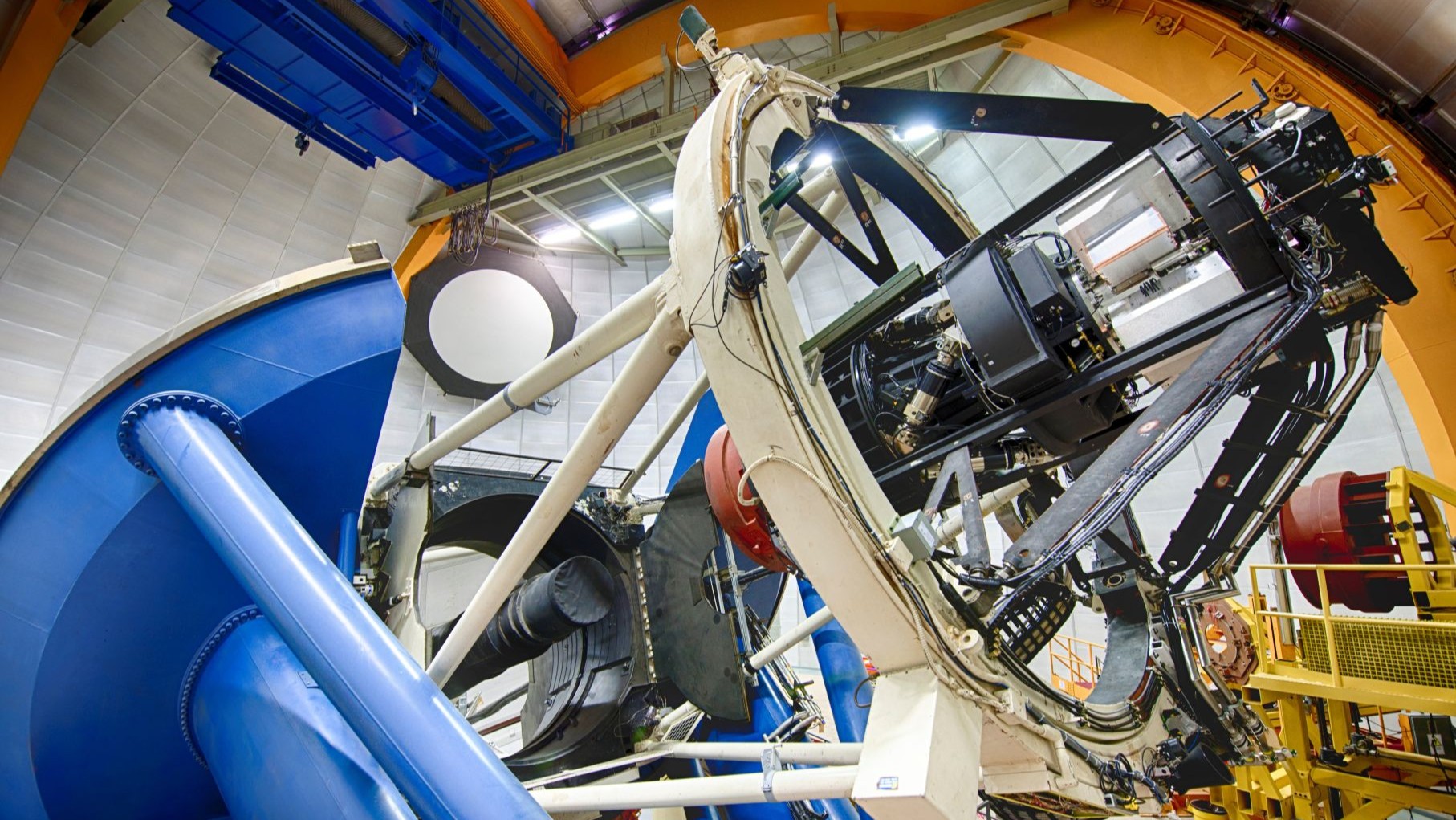
For the Dark Energy Survey, Fermilab built an extremely sensiHve 570-Megapixel digital camera, DECam, and installed it on the Blanco 4-meter telescope at NSF’s Cerro Tololo Inter-American Observatory in the Chilean Andes. Credit: Reidar Hahn, Fermilab
The Dark Energy Survey (DES) combines six years of weak lensing and galaxy clustering data—and unites four dark energy probes from a single experiment for the first time—delivering new, tighter constraints that narrow down the possible models for how the universe behaves.
The Dark Energy Survey (DES) collaboration is releasing new result that, for the first time, combine all six years of data from two key cosmological techniques: weak gravitational lensing and galaxy clustering. The analysis summarizes 18 supporting papers and also presents DES’s first combined results from four independent “dark energy probes”: baryon acoustic oscillations (BAO), type-Ia supernovae, galaxy clusters, and weak lensing—an objective set at the project’s inception 25 years ago.
The analysis tightens constraints on how the universe behaves and narrows down which cosmological models remain viable. The new constraints are more than twice as strong as those from previous DES analyses, while remaining consistent with earlier results.
“What we are finding is that both the standard model and evolving dark energy model fit the early and late universe observations well, but not perfectly,” says Judit Prat, co-lead of the DES weak lensing working group and Nordita Fellow at the Nordic Institute for Theoretical Physics (Nordita), hosted by Stockholm University and KTH Royal Institute of Technology.
Bringing four probes together
This is DES’s first combined measurement using four major techniques designed to constrain dark energy: baryon acoustic oscillations (BAO), type-Ia supernovae, galaxy clusters, and weak gravitational lensing—an approach envisioned when the survey began 25 years ago.
“DES really showcases how we can use multiple different measurements from the same sky images. I think that’s very powerful,” says Martin Crocce, research associate professor at the Institute for Space Science in Barcelona and co-coordinator of the analysis.
“There’s something very exciting about pulling the different cosmological probes together,” says Chihway Chang, associate professor at the University of Chicago and co-chair of the DES science committee.
How DES mapped the cosmos
DES collected observations from 2013 to 2019 using the 570-megapixel Dark Energy Camera (DECam) on the Víctor M. Blanco 4-meter telescope in Chile. Over 758 nights, the survey recorded information from 669 million galaxies, covering one-eighth of the sky.
A major part of the final analysis centers on improved calibration and methodology for weak lensing—tracking how galaxy images are subtly distorted by gravity to reconstruct the universe’s matter distribution over billions of years.
“One of the most exciting parts of the final DES analysis is the advancement in calibrating the data,” says Alexandra Amon, co-lead of the DES weak lensing working group and assistant professor of astrophysics at Princeton University.
Standard cosmology model still fits—but not perfectly
DES tested two models: the standard ΛCDM model, where dark energy is constant, and an extended wCDM model, where dark energy can evolve over time. The data mostly align with ΛCDM, and while wCDM can also fit, it does not fit significantly better than the standard model.
However, one key parameter tied to how matter clusters remain offset from what early-universe measurements predict. With the full dataset included, the gap grows—but not enough to definitively rule out the standard model, and it persists even when DES data is combined with other experiments.
What comes next
The researchers say the next step is to test alternative explanations, including extended dark energy models where w itself is allowed to vary in time and different theories of gravity. The results are also positioned as a major stepping stone toward upcoming next-generation surveys such as the Vera C. Rubin Observatory’s Legacy Survey of Space and Time (LSST).
“The measurements will get tighter and tighter in only a few years,” says Anna Porredon, co-lead of the DES Large Scale Structure working group and senior fellow at CIEMAT in Madrid.
“It’s exciting that we will probably have some of the answers about dark energy in the next 10 years,” Porredon adds.
Dark Energy Survey website: https://www.darkenergysurvey.org/
The DES Collaboration:
DES is an international project with over 400 scientists from 35 institutions in 7 countries, who have come together to carry out the survey. Our team of scientists comprises university faculty and researchers, laboratory and observatory staff scientists, post-doctoral researchers, and graduate and undergraduate students. The support staff are also a critical part of the team: they make it possible for our scientists to travel to Chile to observe for the survey and to travel to conferences and collaboration meetings to discuss the latest results.
Judit Prat carried out this work while a Nordita Fellow. She has recently taken up a position at the University of Copenhagen, DARK (Niels Bohr Institute).